
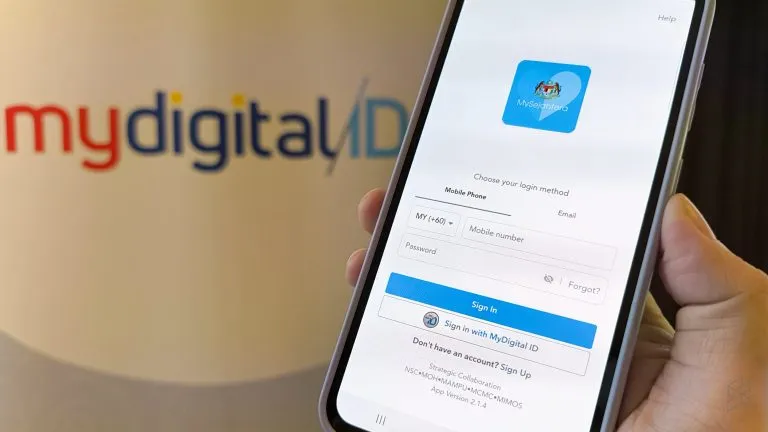
Malaysia’s shift towards digital public services is making digital identity increasingly important.
MyDigital ID is at the centre of that transition. Rather than functioning as another government service application, it acts primarily as a digital identity authentication mechanism that allows Malaysians to prove who they are when accessing participating online services.
Its adoption is also expanding quickly. As of 30 June 2026, 12 million Malaysians had registered for MyDigital ID. By 25 June, 114 government online services had already been integrated with the system, including MyJPJ, MyPTPTN, SPA9 and MyBayar PDRM.
As MyDigital ID becomes connected to more services, questions about privacy, security and accessibility become increasingly relevant.
For M40 households and other digitally active Malaysians, the issue is therefore not simply whether they should download another application. The bigger question is how a national digital identity may affect the way citizens access government platforms, telecommunications, subsidies and eventually more private-sector services.
Key Takeaways
- MyDigital ID is a digital identity verification system, not a replacement for MyKad.
- Identity checks can be made against official government records, including records maintained by the National Registration Department.
- MyDigital ID states that it does not retain users’ personal or biometric data on its servers.
- Registration is currently available to Malaysian citizens without a registration charge.
- As of June 2026, 114 government online services had integrated MyDigital ID.
- Its use has also expanded into BUDI95 access and telecommunications, while financial institutions are testing further applications.
What Is MyDigital ID Malaysia?
MyDigital ID is Malaysia’s national digital identity infrastructure designed to verify an individual’s identity when accessing digital services.
Instead of every participating service having to establish its own identity verification process, MyDigital ID can function as a trusted authentication layer between the user and the service.
According to MyDigital ID, identity verification refers directly to official records maintained by the National Registration Department (JPN). The platform describes JPN’s database as the source used to validate an individual’s identity.
This distinction is important.
MyDigital ID is not intended to become one giant database containing every government service, transaction or personal record. Its central function is identity authentication.
This is also why the concept of Single Sign-On, or SSO, is important to understanding the system. A verified digital identity can potentially be used to authenticate the same individual across multiple integrated services.
1. MyDigital ID Is Your Digital Identity — Not Your Digital MyKad
One common misunderstanding is that MyDigital ID is intended to replace Malaysia’s physical identity card.
It does not.
Official guidance states that MyDigital ID is used for secure online identification and authentication while MyKad remains the physical proof of identity for relevant offline purposes.
The two therefore perform related but different functions.
MyKad establishes a person’s physical identification, while MyDigital ID provides a mechanism for proving identity when dealing with participating digital systems.
The distinction will become increasingly relevant as more services move online.
A user may still possess and use a MyKad while also using MyDigital ID to authenticate themselves digitally.
2. Does MyDigital ID Store Your Personal Data?
Privacy is one of the most important questions surrounding any national digital identity system.
MyDigital ID states that it operates using a zero data retention approach, meaning user information is not stored on its servers as a separate personal database.
Its current support documentation states that data in transit is encrypted, user information is processed temporarily for authentication and personal data is not retained by the MyDigital ID server.
The organisation has also clarified that MyDigital ID does not track users’ online activities or collect new information simply because someone uses the service to log in.
Instead, its role is to confirm that a person attempting to access a participating service is the person they claim to be.
This creates an important distinction between verifying data and storing data.
The service may need to refer to trusted information to perform authentication, but according to MyDigital ID, it does not create its own central repository containing users’ personal records.
3. What About Fingerprints and Facial Recognition?
The role of biometrics requires another distinction.
MyDigital ID states that it does not store users’ biometric data, including fingerprints or facial recognition information.
However, biometrics can still be involved in authentication.
Newer versions of the MyDigital ID application support local device biometric authentication, allowing users to use a fingerprint or facial recognition feature available on their own smartphone instead of entering a password for every login.
According to MyDigital ID, this biometric information remains within the user’s device and is not transmitted to an external server.
That difference matters from a privacy perspective.
Using biometrics does not automatically mean that the MyDigital ID platform itself is building a national fingerprint or facial recognition database.
4. How Is MyDigital ID Intended to Improve Security?
One of the objectives of digital identity is to make impersonation more difficult.
Traditional online accounts often rely on usernames, passwords and personal information that can be stolen through phishing or reused across multiple sites.
With MyDigital ID, participating services can instead authenticate a user through a digital identity that has already been verified against government records.
The system also allows website login through methods such as QR authentication without requiring the user’s MyDigital ID password to be transmitted to the service provider.
This can reduce certain password-related risks, although the security of the service being accessed still depends on the security practices of that individual provider.
MyDigital ID has also stated that its infrastructure is being developed with security frameworks including Common Criteria, NIST and ISO/IEC standards.
The wider policy objective is therefore not to claim that cyber risks disappear completely, but to strengthen the assurance that the individual accessing a digital service has a verified identity.
5. Where Can MyDigital ID Already Be Used?
The scale of integration is now one of the clearest indicators that MyDigital ID is moving beyond its early rollout phase.
As of 25 June 2026, 114 government online services had been integrated with MyDigital ID.
Examples include:
- MyJPJ;
- MyPTPTN;
- SPA9;
- MyBayar PDRM; and
- MyGOV Malaysia.
At state level, 19 applications had also been integrated, while additional state systems were under development.
MyJPJ provides a useful example of the direction of travel. MyDigital ID’s Single Sign-On integration with the application took effect on 1 May 2026, allowing users to authenticate their identity through MyDigital ID when accessing MyJPJ services.
What About BUDI95?
MyDigital ID also has a role in accessing the BUDI MADANI RON95 or BUDI95 portal.
The official BUDI95 login guide allows users to scan a MyDigital ID QR code using the MyDigital ID application when logging in or registering with the portal.
This does not mean MyDigital ID itself determines an individual’s subsidy eligibility.
Rather, it provides an identity authentication route into the relevant digital service.
That distinction is important: identity verification and policy eligibility are not the same thing.
The agency operating a programme still determines the rules of that programme.
Telecommunications Are Another Major Expansion Area
Telecommunications providers began integrating MyDigital ID into their mobile applications from December 2025.
The initiative includes three areas:
- checking prepaid mobile numbers registered under a user’s MyKad;
- verifying identity for new prepaid SIM registrations; and
- providing MyDigital ID as a login option for telecommunications applications.
Implementation can vary between telecommunications providers and is being rolled out in stages.
The policy objective is significant because mobile numbers are frequently used as part of online account authentication.
Connecting a phone number more reliably to a verified individual could therefore form another layer in efforts to reduce identity abuse and fraudulent SIM registrations.
Is MyDigital ID Expanding Into Banking?
Potentially, but it is important to distinguish between integration that already exists and partnerships that are still being implemented.
In February 2026, My Digital ID Sdn Bhd signed memoranda of understanding with 15 banks, e-wallet companies and fintech firms.
The organisations included Maybank, CIMB Bank, Public Bank, RHB Bank, Hong Leong Bank, AmBank, Bank Islam, Touch ‘n Go Digital and several digital finance providers.
Under the initiative, MyDigital ID e-verification technology is to be tested and implemented for areas such as customer onboarding and transaction verification.
The announcement therefore signals the direction of expansion, but it should not be interpreted as meaning every participating bank already requires MyDigital ID for all customers or transactions.
6. Is Registration Free?
Yes.
Malaysia’s MyGovernment portal states that MyDigital ID registration for Malaysian citizens carries no charge.
The service is available online and through the MyDigital ID mobile application.
This matters for digital inclusion. A national identity mechanism that becomes increasingly connected to essential public services needs to remain broadly accessible rather than being dependent on a paid registration model.
However, financial cost is only one dimension of access.
Users must also have an appropriate device, understand the registration and authentication process, maintain access to their account and be able to recover from situations such as changing or losing a device.
Why Should Malaysia’s M40 Pay Attention?
There is no separate MyDigital ID system or registration requirement specifically for M40 households.
The relevance to M40 comes instead from the types of services becoming connected to digital identity.
Government administration, transport services, education financing, subsidies, telecommunications and potentially financial services increasingly involve digital interaction.
For working households managing several of these services, identity authentication can therefore become part of routine administration rather than an occasional digital exercise.
This changes how MyDigital ID should be understood.
It is becoming less useful to think of it as simply another application installed on a smartphone.
It increasingly acts as part of the infrastructure connecting an individual to other digital services.
The Future Research Analysis: Trust, Access and Interoperability
The Future Research identifies three tests that will determine the long-term significance of MyDigital ID:
1. Trust
Users need confidence that identity verification does not unnecessarily expand the storage, tracking or exposure of their personal information.
Technical safeguards matter, but clear public communication about how information moves between MyDigital ID, JPN and participating services is equally important.
2. Access
A national digital identity becomes more consequential as more essential services depend on it.
Policy evaluation should therefore consider not only how many people have registered but whether citizens can reliably authenticate themselves, recover access when problems occur and obtain alternatives where necessary.
3. Interoperability
The largest potential benefit comes when one trusted identity can function across many services without requiring citizens to repeatedly create new credentials and complete separate identity checks.
The 12 million registered users and 114 integrated government services recorded by June 2026 suggest that MyDigital ID has already moved into a significant expansion phase.
For The Future Research, this makes MyDigital ID more accurately understood as digital public infrastructure rather than simply another government application.
Its long-term value will therefore depend not only on adoption numbers but on whether the infrastructure remains secure, accessible and interoperable as the number of connected services grows.
What Should Be Watched Next?
Several indicators will show whether MyDigital ID is developing into effective national digital infrastructure.
First is service coverage. The number and importance of government and private services using MyDigital ID will determine how relevant it becomes to everyday life.
Second is access continuity. As Single Sign-On becomes more common, mechanisms for account recovery, device changes and alternative access will become increasingly important.
Third is private-sector adoption. Banking, e-wallet, fintech and telecommunications integrations could significantly broaden the role of digital identity beyond government services.
Finally, public trust must be monitored alongside technical expansion. Cybersecurity standards alone cannot guarantee adoption if users do not understand what information is being verified, where it is stored and who can access it.
Conclusion
MyDigital ID is moving beyond the stage of being simply a new government application.
With 12 million Malaysians registered by the end of June 2026 and more than 100 government services already integrated, it is increasingly becoming part of Malaysia’s digital service infrastructure.
The system does not replace MyKad. Its purpose is to authenticate identity online, with verification linked to trusted government records.
MyDigital ID also states that it does not maintain a personal or biometric database of its users, while newer biometric login functions operate locally on supported devices.
For Malaysians, including M40 households, the key issue is therefore bigger than registration itself.
As digital identity becomes connected to more services, its success will depend on three things working together:
strong security, clear privacy safeguards and reliable access.
FAQ
MyDigital ID is Malaysia’s national digital identity infrastructure for secure online identity authentication. It verifies an individual’s identity against trusted government records so that participating online platforms can confirm that the person accessing a service is the legitimate user. It can also function as a Single Sign-On mechanism across integrated services.
No. MyDigital ID does not replace MyKad. MyKad remains Malaysia’s physical identity document, while MyDigital ID is designed primarily for online identification and authentication. The two perform different functions even though both relate to verifying a person’s identity.
MyDigital ID states that it does not retain a separate database containing users’ personal data on its servers. Identity verification refers to trusted government records, while information required during authentication is processed temporarily. The organisation also states that it does not track users’ general online activity.
MyDigital ID states that it does not store biometric information such as fingerprints or facial recognition data. Its current application supports local biometric authentication on compatible smartphones, but according to MyDigital ID, this biometric information remains on the user’s device rather than being transmitted to external servers.
Yes. The MyGovernment portal lists MyDigital ID registration for Malaysian citizens as having no registration charge. Registration can be carried out online using the mobile application, subject to the relevant identity verification process.