
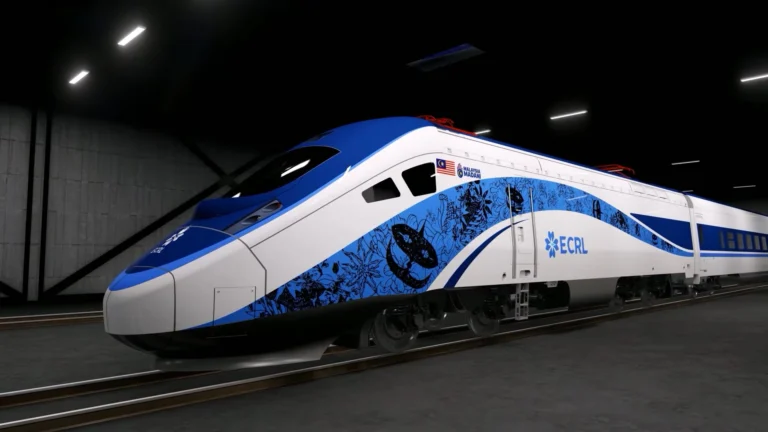
The East Coast Rail Link (ECRL) is moving closer to becoming part of Malaysia’s transport network, bringing with it a major change in connectivity between the East Coast and the Klang Valley.
Malaysia Rail Link (MRL) reported that construction of the project had reached 94% as of May 2026. Commercial operations between Kota Bharu and the Gombak Integrated Terminal are scheduled to begin in January 2027, while the extension between Gombak and Port Klang is expected to become fully operational in January 2028.
For Kelantan and Terengganu, however, the significance of the ECRL goes beyond having a new railway.
The larger question is whether improved connectivity can translate into greater movement of goods, tourists, investment and business activity — and whether local communities and businesses are positioned to capture those opportunities.
Key Takeaways
- The ECRL is expected to reduce the Kota Bharu–Gombak journey to around four hours.
- Passenger-and-cargo stations could strengthen the logistics sector in Kelantan and Terengganu.
- Easier access from the Klang Valley may widen the potential domestic tourism market.
- SMEs and producers could gain better access to supply chains and markets outside the East Coast.
- Economic activity around ECRL stations could create opportunities for services, property development and employment.
1. Faster Access to the Klang Valley
One of the most immediate changes created by the ECRL will be reduced travel time between the East Coast and the Klang Valley.
MRL expects passenger trains to connect Kota Bharu and the Gombak Integrated Terminal in approximately four hours, compared with around seven hours by road under normal conditions. Passenger Electric Multiple Unit trains are designed for speeds of up to 160km/h.
Terengganu will also gain a new direct rail connection towards the Klang Valley through stations including Jerteh, Bandar Permaisuri, Kuala Terengganu, Dungun, Kemasik and Chukai.
Reduced travel time matters economically because distance is not measured only in kilometres. For businesses, workers and travellers, it is also measured through time, reliability and transport costs.
A more predictable journey could make business meetings, short domestic trips and movement between economic centres easier.
However, rail connectivity alone will not determine accessibility. Transport connections between ECRL stations and city centres, tourism destinations, airports and surrounding districts will also influence how useful the network becomes.
2. A New Boost for Trade and Logistics
The ECRL is designed to transport both passengers and freight, making logistics one of its most important potential economic functions.
In Kelantan, Pasir Puteh Station at Cherang Tuli is designated for both passenger and cargo services, while Kota Bharu Station at Bandar Baru Tunjong will serve passengers.
Terengganu will have an even larger ECRL footprint. MRL has stated that Dungun and Chukai will serve both passengers and cargo, while Jerteh, Bandar Permaisuri, Kuala Terengganu and Kemasik will be passenger stations.
This creates potential logistics nodes where manufacturers, agricultural producers, distributors and other industries may be able to connect more efficiently with markets outside the East Coast.
The wider ECRL strategy also includes stronger connections between the rail network and major ports. ECERDC describes the ECRL as a key part of the region’s logistics transformation, particularly through faster passenger and cargo movement between the East Coast and the Klang Valley.
For Kelantan and Terengganu, the real economic test will therefore be freight utilisation.
Cargo stations have economic value when firms actually use them, logistics services develop around them and the rail network becomes integrated with local production centres.
3. More Tourists for the East Coast
Tourism could be another major beneficiary of better connectivity.
Kelantan and Terengganu already have established tourism assets ranging from cultural and food tourism to islands, beaches, heritage destinations and nature-based attractions.
The ECRL could expand their potential visitor market by making the East Coast easier to reach from the Klang Valley.
A shorter and more predictable journey could encourage weekend trips, short holidays and domestic travel among visitors who may currently consider the road journey too long or inconvenient.
ECERDC’s current regional development strategy also treats transport connectivity as an enabler for tourism. Its plans include strengthening links between airports, ECRL stations and tourism destinations to improve visitor mobility across the East Coast Economic Region.
Still, an ECRL station does not automatically translate into additional tourism spending.
Visitors must also be able to move conveniently from stations to hotels, town centres, islands and attractions. Local shuttle services, car rental, buses, tourism packages and integrated travel information could therefore influence how much tourism activity actually reaches local businesses.
4. Bigger Markets for Local Businesses
Better transport connectivity could also change the market available to local businesses.
Kelantan and Terengganu have significant numbers of small businesses, food producers, traders, agricultural enterprises and manufacturers. Improved rail connectivity could make it easier for some of these businesses to reach customers and supply chains beyond the East Coast.
ECERDC has previously highlighted improved logistics as an opportunity for Kelantan’s MSMEs, including stronger connections between local businesses, regional markets and trade infrastructure.
The potential opportunity is broader than simply transporting products by train.
Greater passenger movement can also increase demand for local food, accommodation, transport, retail and services.
For SMEs, however, accessibility to a larger market also means greater competition.
Businesses that want to benefit from improved connectivity may need to strengthen production capacity, packaging, distribution, digital visibility and product standards so that better infrastructure translates into actual market expansion.
The ECRL could therefore reduce one barrier — distance — without automatically solving other constraints faced by smaller businesses.
5. New Growth Around ECRL Stations
The areas surrounding ECRL stations could become another source of economic activity.
Rail stations can attract services such as retail, accommodation, transport, offices and commercial development when passenger volumes and surrounding land use support them.
This potential is already visible in Terengganu’s planning.
In 2025, MRL and the Terengganu state government signed a Memorandum of Understanding to facilitate transit-oriented development (TOD) around ECRL stations in the state.
In February 2026, the Dungun local authority also highlighted planning for the ECRL TOD area at Batu Tujuh, including supporting infrastructure and long-term development around the station.
If properly integrated with surrounding communities, station areas could attract commercial activity, services and property investment while supporting new employment opportunities.
But development around stations should not be measured only by the amount of new construction.
The more important measure will be whether these developments create economic links with existing communities and businesses rather than becoming isolated commercial areas.
The Future Research Analysis: From Connectivity to Economic Conversion
The ECRL provides new infrastructure, but infrastructure itself is only the first stage of regional economic transformation.
The Future Research identifies four factors that could determine how successfully Kelantan and Terengganu convert ECRL connectivity into local economic value: last-mile connectivity, freight adoption, SME participation and station-area development.
First, passengers need efficient connections between stations and their final destinations.
Second, manufacturers and producers need commercially viable ways to use the freight network.
Third, SMEs need the capacity to reach the larger markets that improved connectivity creates.
Finally, development around stations needs to connect with local economies rather than operate independently from them.
This distinction is important.
The opening of a railway can increase flows of people and goods. But regional economic impact depends on how much of those flows are converted into local spending, investment, business expansion and employment.
For Kelantan and Terengganu, the challenge after January 2027 may therefore shift from infrastructure delivery to economic utilisation.
What Should Be Watched Next?
Several indicators will help determine whether the ECRL produces meaningful economic spillovers in Kelantan and Terengganu.
Passenger demand will show whether travellers are willing to shift from road and air transport to rail.
Freight utilisation will indicate whether businesses and logistics companies see commercial value in using ECRL cargo services.
Last-mile connectivity will determine whether stations are effectively linked to city centres, industrial areas, airports and tourism destinations.
SME participation will show whether local producers and service businesses are capturing new markets created by improved access.
Finally, development around stations will reveal whether ECRL becomes a catalyst for wider economic clusters or remains primarily a transport corridor.
Conclusion
The ECRL could significantly change the economic geography of Kelantan and Terengganu by reducing travel time, strengthening freight connections and creating new links with the Klang Valley.
The first commercial phase between Kota Bharu and Gombak is currently scheduled to begin in January 2027, while the connection to Port Klang is expected to become fully operational in January 2028.
Yet the biggest opportunity may not simply be the railway itself.
Its longer-term impact will depend on how effectively both states use that connectivity to expand tourism, improve logistics, help businesses access larger markets and develop productive economic activity around ECRL stations.
The next phase of the ECRL story will therefore be less about building the railway — and more about what Kelantan and Terengganu build around it.
FAQ
Commercial operations on the first ECRL phase between Kota Bharu and the Gombak Integrated Terminal are currently scheduled to begin in January 2027. The second phase between Gombak and Port Klang is expected to become fully operational in January 2028.
Malaysia Rail Link estimates that the ECRL passenger service will connect Kota Bharu and Gombak in approximately four hours. This compares with an estimated seven hours by road under normal travel conditions, although actual future journey times may depend on the final operating schedule.
In Kelantan, Pasir Puteh Station will serve passengers and cargo, while Kota Bharu Station is designated for passengers. In Terengganu, Dungun and Chukai are designated as combined passenger-and-cargo stations. The state’s other four ECRL stations are intended for passenger services.
The ECRL could support employment through logistics, tourism, retail, transport services and development around stations. However, the number and type of jobs will depend on how much new investment and business activity the railway generates. Improved infrastructure creates economic capacity, but employment outcomes depend on how businesses and governments use that capacity.
The ECRL could make the East Coast easier to reach from the Klang Valley and other connected areas, potentially supporting more domestic tourism. Its impact will also depend on last-mile transport between ECRL stations and destinations such as city centres, hotels, beaches, islands and cultural attractions.