
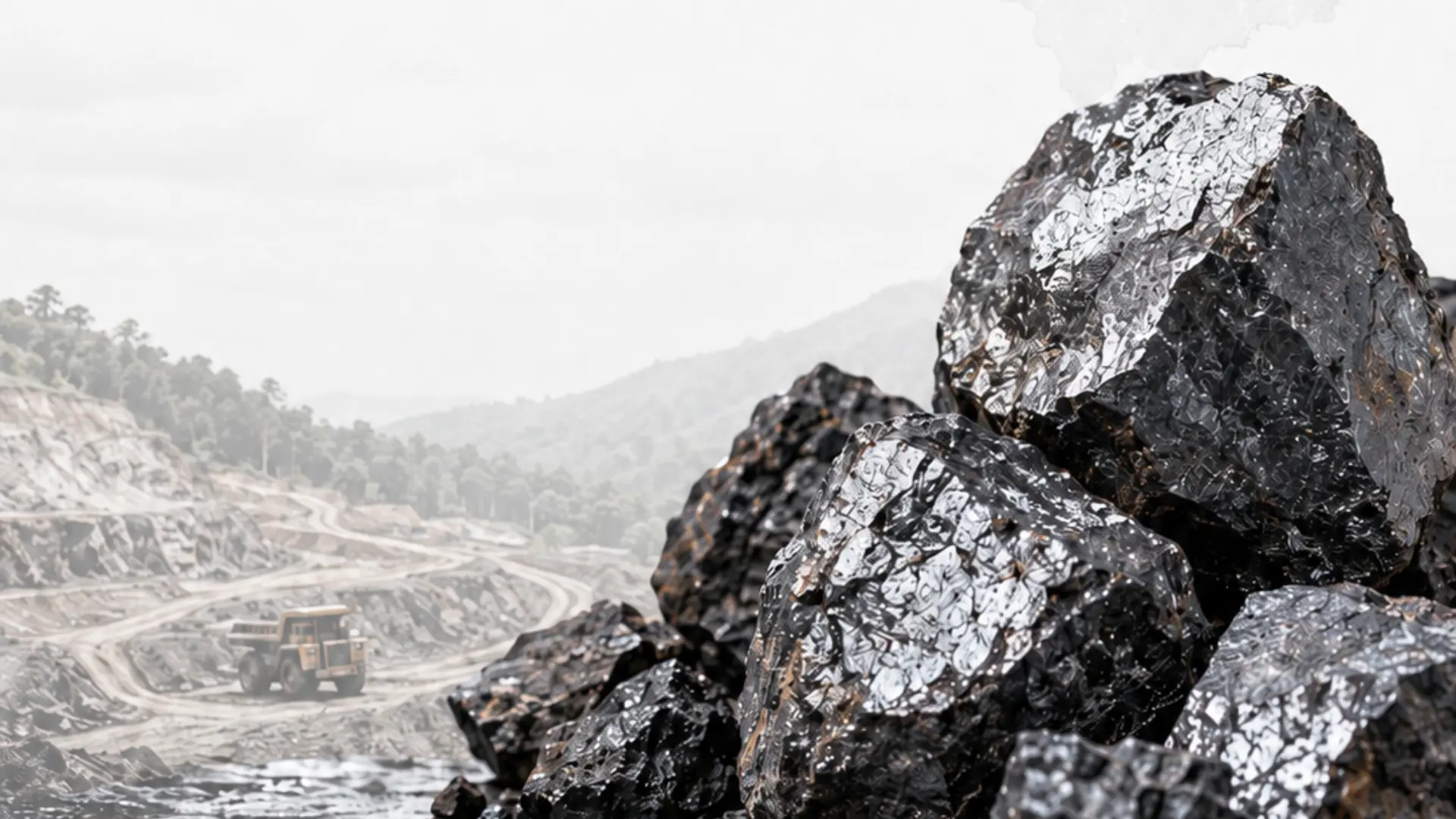
Kelantan’s connection with manganese is not a recent discovery. Geological records stretching back several decades document manganese occurrences in different parts of the state, while more recent Environmental Impact Assessment (EIA) records show continued commercial interest in the mineral.
That history matters because manganese remains an important industrial mineral. It is widely used in steelmaking and also plays a role in several battery technologies.
However, the existence of manganese does not automatically mean that every deposit can support a profitable mining industry. Ore quality, resource size, extraction costs, environmental safeguards and downstream demand all determine whether geological potential can become sustainable economic value.
For Kelantan, the evidence therefore points to an opportunity worth examining — but one that requires more than the presence of mineral deposits.
Key Takeaways
- Kelantan has documented manganese occurrences going back several decades.
- Historical records identify locations including Gual Periok and Ulu Lebih.
- JMG produced a dedicated assessment of iron and manganese resources in Kelantan in 2012.
- Two separate manganese mining proposals in Aring 6 underwent public EIA processes in 2021.
- Manganese has economic relevance to steelmaking and emerging battery supply chains.
- Geological occurrence alone does not establish commercial viability.
- Environmental management will remain central to any future development.
Kelantan’s Manganese History Goes Back Decades
Official geological records show that manganese exploration in Kelantan is not new.
A record in the library of the Jabatan Mineral dan Geosains Malaysia (JMG) refers to Notes on the Manganese Deposits South of Gual Periok, Kelantan. The record states that prospecting had taken place at Bukit Gharu and Bukit Tandok. Surveys and preparations for drilling at Bukit Tandok were also documented.
JMG record on manganese deposits south of Gual Periok
Another JMG catalogue record provides evidence from another part of the state. A report titled Manganese Deposit Mukim of Ulu Lebih District of Ulu Kelantan by D. Santokh Singh dates to 1966.
These records are significant because they indicate that manganese occurrences were documented in more than one location.
They also show that interest in Kelantan’s manganese resources predates the recent debate over critical minerals, electric vehicles and modern battery supply chains.
JMG Conducted a Dedicated Resource Assessment
Government interest continued in later decades.
In 2012, JMG Kelantan produced a report titled Penilaian Sumber Bijih Besi dan Mangan Negeri Kelantan, or Assessment of Iron Ore and Manganese Resources in Kelantan.
The JMG catalogue identifies John Joseph Jinap and Che Abdul Rahman Jaafar as the authors and categorises the publication under iron, manganese and economic geology.
JMG 2012 iron and manganese resource assessment
The existence of a dedicated state-level assessment is important.
It does not by itself prove that Kelantan possesses commercially recoverable manganese reserves at a particular scale. However, it demonstrates that the mineral has received formal geological and resource-assessment attention.
That distinction is important when discussing economic potential.
A documented mineral occurrence is the beginning of the assessment process. Commercial development requires much more detailed information on ore grade, tonnage, mineability, processing requirements and market conditions.
What Happened at Aring 6?
More recent evidence shows that commercial interest did not disappear.
In 2021, the Department of Environment Malaysia (DOE) published an EIA notification for proposed manganese ore mining operations on Lot PT 7306 at Aring 6, Mukim Relai, in the Gua Musang area.
The proposed site covered 202.37 hectares, or approximately 500 acres. The DOE notification identified Nadi KW Sdn Bhd as the project proponent.
DOE EIA notice for the 202.37-hectare Aring 6 project
The same year, DOE also published an EIA notification for another proposed manganese mining operation at Aring 6.
That proposal involved Lot PT 9595 and Lot 16088, with a combined area of 174.16 hectares, or around 430.40 acres. The report went through a public exhibition period from 7 October to 5 November 2021.
DOE EIA notice for the 174.16-hectare proposal
The two records should not be interpreted as evidence that both projects subsequently entered production.
What they demonstrate is that separate manganese mining proposals reached the environmental assessment stage.
That itself provides evidence of continued development interest in Kelantan’s manganese resources.
Why Does Manganese Have Economic Value?
Manganese is not simply another mineral commodity.
According to the U.S. Geological Survey (USGS), manganese is essential to iron and steel production because of its alloying and deoxidising properties. Steelmaking accounts for most manganese demand in the United States, at around 85% to 90%.
USGS manganese statistics and information
Manganese also has growing relevance to the battery sector.
The International Energy Agency (IEA) identifies manganese among battery-related minerals and notes increasing interest in manganese-rich lithium-ion and sodium-ion battery technologies.
Its Global Critical Minerals Outlook 2025 also highlights heavy concentration in the refining market. China currently produces about 95% of high-purity manganese sulphate, an important material for several emerging battery chemistries.
The IEA estimates that announced projects for high-purity manganese sulphate would meet only around 55% of expected demand in 2035 under its stated policy scenario.
IEA Global Critical Minerals Outlook 2025
However, this global opportunity should not be confused with the geological evidence in Kelantan.
The presence of manganese ore in Kelantan does not automatically mean that the deposits are suitable for battery-grade manganese sulphate.
That would require mineralogical testing, processing studies, commercial assessment and downstream refining capability.
Where Could the Economic Opportunity Come From?
The most important economic question is therefore not simply:
“Does Kelantan have manganese?”
Existing geological records already show that manganese occurs in the state.
The stronger question is:
“Can those resources generate competitive and sustainable economic value?”
There are several possible levels of value creation.
The first is upstream activity, including exploration, geological services, mine development, equipment, transport and supporting services.
The second is mineral processing. Processing ore locally could potentially retain more economic value than exporting unprocessed material, provided that the resource quality, economics and environmental requirements support such investment.
The third is downstream development.
Globally, resource-rich economies increasingly face the question of whether they should remain raw-material suppliers or build capabilities further along the mineral value chain.
For manganese, this can include ferroalloys, refined manganese products and, at the more specialised end, materials used in batteries.
Yet moving downstream requires substantial capital, technology, reliable energy, specialised skills and long-term demand.
Kelantan therefore cannot assume that downstream development will automatically follow mining.
Environmental Governance Is Part of the Economic Equation
Mining potential also creates environmental responsibilities.
The two Aring 6 EIA processes show that proposed manganese development already intersects with environmental assessment and public scrutiny.
This should not be viewed as separate from economic development.
Environmental risk can directly affect project costs, approvals, community acceptance and the long-term sustainability of resource development.
Research into groundwater in the lower Kelantan River Basin provides another reason for careful monitoring.
A 2021 study published in Environmental Earth Sciences found anomalously high concentrations of naturally occurring iron and manganese in shallow groundwater in parts of the basin. The researchers linked the metals primarily to natural geochemical processes and mineral dissolution.
Study on iron and manganese in the lower Kelantan River Basin
Importantly, this groundwater research does not establish that mining caused the manganese concentrations.
Instead, it demonstrates how strongly geology can interact with water quality.
For future mineral development, baseline groundwater data and continued monitoring would therefore be particularly important.
The Future Research Analysis: Four Tests for Kelantan’s Manganese Potential
The Future Research identifies four practical tests for evaluating Kelantan’s manganese opportunity:
- Geological Value
Is there sufficient quantity and ore quality to justify commercial extraction? - Commercial Viability
Can the resource compete after extraction, processing, transport and compliance costs? - Environmental Sustainability
Can water, biodiversity, land disturbance and rehabilitation risks be managed credibly? - Local Value Creation
Can development generate local skills, services, processing capacity and higher-value economic activity rather than relying mainly on raw mineral extraction?
This framework shifts the discussion from simply asking whether manganese exists to asking whether the resource can produce sustainable economic value.
Conclusion
Kelantan’s manganese story extends across several decades.
Historical records document prospecting around Gual Periok and Ulu Lebih. JMG later conducted a dedicated iron and manganese resource assessment, while two proposed mining projects in Aring 6 entered the EIA process in 2021.
Together, these records establish that manganese forms part of Kelantan’s geological and development landscape.
At the same time, economic potential should not be overstated.
The real opportunity depends on whether commercially viable resources can be identified, developed responsibly and connected to activities that retain greater value locally.
For Kelantan, manganese should therefore be viewed not simply as a mineral underground, but as a resource whose value will ultimately depend on geology, economics, environmental governance and development strategy.
FAQ
Yes. Historical JMG records document manganese occurrences and prospecting in several parts of Kelantan, including Gual Periok and Ulu Lebih. However, documented occurrence does not automatically mean that every deposit is commercially viable for mining.
Historical records identify manganese-related activity around Gual Periok, including Bukit Gharu and Bukit Tandok. JMG also holds a 1966 report on a manganese deposit in Mukim Ulu Lebih, Ulu Kelantan.
DOE records show that at least two proposed manganese mining operations at Aring 6, Mukim Relai, went through EIA processes in 2021. These EIA records demonstrate proposed development but should not automatically be interpreted as proof that the projects are currently operating.
Manganese is primarily used in steelmaking. It is also relevant to several battery technologies. The IEA has highlighted high-purity manganese sulphate as an increasingly important material in emerging battery supply chains.
Potentially, but the economic value depends on resource quantity, ore quality, extraction costs, environmental requirements, processing capability and market demand. Greater value may be created if viable mining connects with local services, processing and downstream industries.