
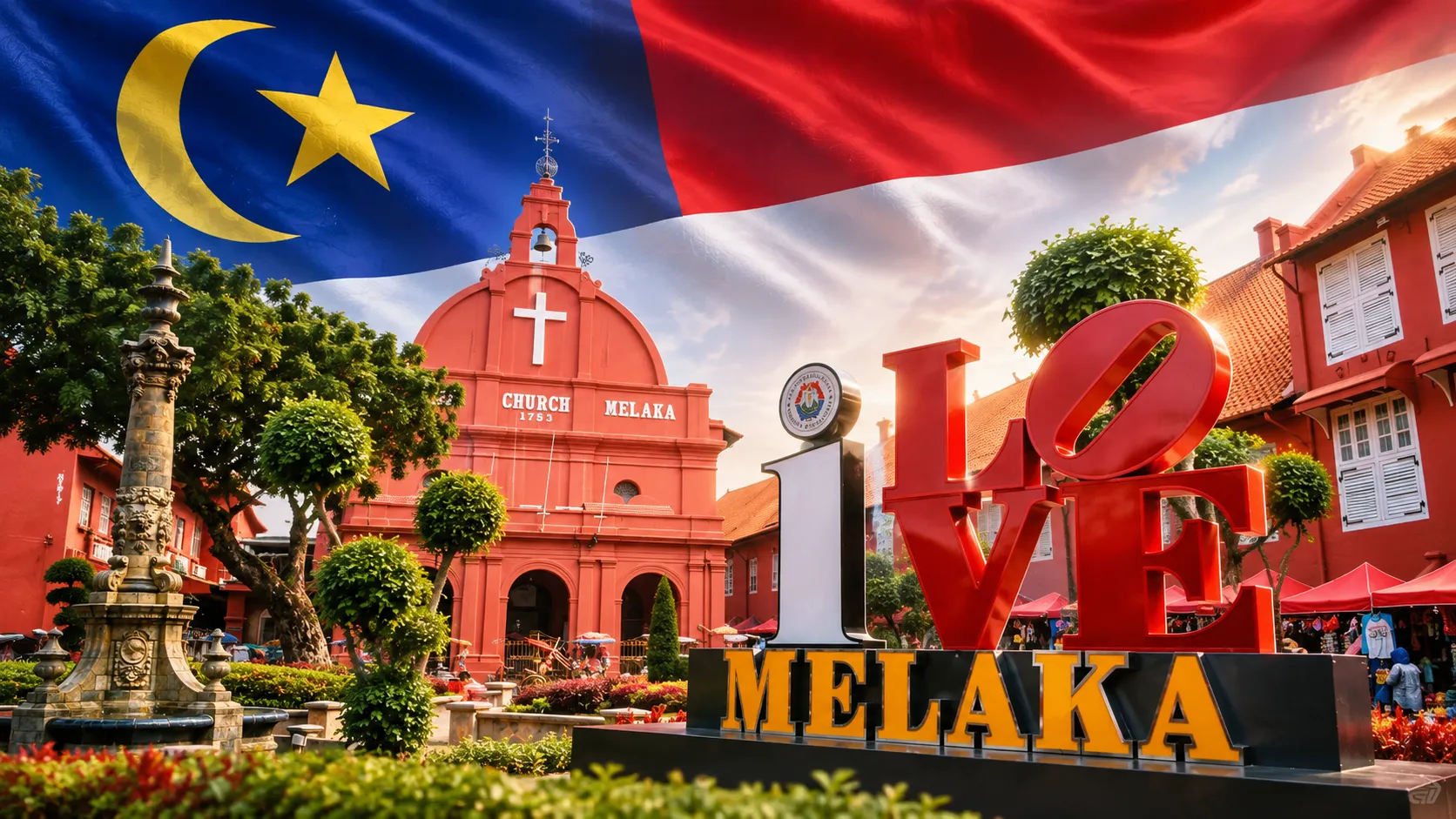
Malaysia’s coalition politics may be entering another period of adjustment.
Following recent cooperation between Barisan Nasional (BN) and Perikatan Nasional (PN) in Negeri Sembilan, attention is now turning to Melaka, where another state election is approaching.
The question is no longer simply whether BN and PN can work together. The more important question is whether the formula can work under Melaka’s own electoral conditions — and whether voters themselves are prepared to accept it.
As of early September 2026, no formal BN-PN electoral alliance for Melaka has been announced. BN chairman Ahmad Zahid Hamidi has, however, authorised Melaka Chief Minister and state BN chairman Ab Rauf Yusoh to negotiate with potential partners. PN chairman Ahmad Samsuri Mokhtar has separately said PN is prepared to hold discussions with BN.
That leaves Melaka in an important political position: cooperation remains possible, but its shape and electoral consequences remain uncertain.
Key Takeaways
- BN and PN have not formally announced an electoral alliance in Melaka.
- BN won 21 of Melaka’s 28 state seats in 2021, while PH won five and PN two.
- Some voters interviewed by The Future Research viewed BN-PN cooperation positively, particularly as a way to avoid three-cornered contests.
- However, party cooperation does not automatically mean voters from both coalitions will support a common candidate.
- The Melaka election could provide another indication of whether BN-PN cooperation can develop into a broader electoral strategy ahead of GE16.
What Is Happening Between BN and PN in Melaka?
BN currently enters the Melaka discussion from a position of significant state-level strength.
In the November 2021 election, BN captured 21 of the state’s 28 constituencies, compared with five for Pakatan Harapan (PH) and two for PN. The turnout was 65.85 per cent.
This means any cooperation negotiations are unlikely to start from an equal division of seats.
Ab Rauf has already indicated that the 21 seats won by BN would form the starting point of its negotiations, although some adjustments could potentially occur.
PN, meanwhile, has indicated that it is prepared to negotiate.
Ahmad Samsuri said on 9 August that talks should ideally take place before the dissolution of the state assembly. He also acknowledged that reaching a new political understanding would require negotiation, tolerance and patience.
However, BN itself has remained cautious.
Ahmad Zahid said in August that grassroots sentiment over possible cooperation was mixed and that the coalition was conducting a detailed assessment before making a decision.
Therefore, references to a “BN-PN formula” in Melaka should currently be understood as a political possibility rather than a completed alliance.
What Are Melaka Voters Saying?
The Future Research went to the ground to hear how some Melaka voters viewed the possibility of BN-PN cooperation.
Among those interviewed, some believed cooperation could strengthen the two coalitions’ electoral prospects by avoiding direct competition against one another and reducing three-cornered contests.
There were also respondents who expressed a preference for BN to cooperate with PN rather than PH.
These interviews offer useful qualitative insight into voter thinking, but they should not be interpreted as a representative opinion poll of Melaka voters as a whole. No broader conclusion about statewide voter preference should be drawn without systematic polling.
What the responses do show is that coalition arrangements themselves have become part of the calculation voters are making ahead of the state election.
The question is no longer only which party should win? It is also which parties should work together?
Why Do Three-Cornered Contests Matter?
One of the strongest arguments put forward by supporters of BN-PN cooperation is the possibility of avoiding three-cornered contests.
The electoral logic is straightforward.
When several parties appeal to overlapping groups of voters, competing against one another can divide those votes. A coordinated seat arrangement could instead produce more direct contests against a common opponent.
However, this should not be reduced to simple political arithmetic.
If Party A received 30 per cent of the vote and Party B received 20 per cent in a previous election, cooperation does not automatically create a 50 per cent voting bloc.
Voters may reject the agreed candidate. Some may abstain. Others may shift to another coalition.
That makes vote transferability one of the most important variables in any BN-PN arrangement.
The Future Research therefore identifies three tests for a possible BN-PN formula in Melaka:
- Electoral complementarity — can the parties divide seats without damaging their existing local strengths?
- Grassroots transferability — will supporters of one coalition genuinely vote for a candidate from the other?
- Governance credibility — can the cooperation produce a clear and workable governing arrangement after the election?
The first can be negotiated by political leaders. The second ultimately depends on voters.
The Negeri Sembilan Precedent
Melaka is also being watched because of what happened recently in neighbouring Negeri Sembilan.
In the August 2026 state election, BN won 18 seats and PN seven. Together, the two coalitions secured enough seats to form the new state government. PH won 11 seats.
That result has naturally increased discussion about whether a similar political arrangement could be used elsewhere.
But copying the Negeri Sembilan formula directly would overlook an important point: state elections have different political structures.
BN already holds 21 of the 28 seats in Melaka. Its bargaining position, incumbent advantage and local organisational interests are therefore different.
BN chairman Ahmad Zahid himself has said the Melaka formula does not necessarily have to follow the same approach used elsewhere and should instead reflect Melaka’s own political landscape.
This distinction matters.
Melaka is not simply the “next Negeri Sembilan”. It is another test of whether political cooperation can be adapted to local conditions.
Could a Stronger Mandate Bring Greater Stability?
Some of the Melaka voters interviewed by The Future Research also associated a stronger electoral mandate with political stability and smoother implementation of state development programmes.
There is a reasonable governance question behind that view.
A government with a comfortable legislative majority may face fewer risks of losing confidence votes or becoming dependent on unstable post-election arrangements.
However, electoral strength and development performance should not be treated as the same thing.
A large majority can provide political stability, but effective development still depends on factors such as administrative capacity, fiscal management, project execution, accountability and coordination between state and federal institutions.
Therefore, the more useful question is not simply whether a BN-PN arrangement could produce a larger majority.
It is whether such a majority would be translated into predictable government, effective implementation and measurable outcomes for Melaka residents.
The Future Research Analysis: Three Things to Watch
From an electoral and policy perspective, The Future Research identifies three developments that could determine whether the BN-PN formula becomes meaningful in Melaka.
1. Seat Negotiations
BN has a strong incumbent position after winning 21 seats in 2021.
Any negotiation that requires BN to surrender or exchange constituencies could therefore become sensitive at the divisional and grassroots levels.
2. Voter Transfer
Political elites can agree on candidates, but they cannot automatically transfer voter loyalty.
The clearest test will be whether BN supporters are willing to vote for PN candidates in seats allocated to PN — and vice versa.
3. The Post-Election Arrangement
Electoral cooperation also raises a governance question.
Would the arrangement merely prevent parties from competing against each other, or would it involve a clearer agreement on governing roles, policy priorities and decision-making after the election?
This distinction could influence how voters judge the credibility of the formula.
Could Melaka Shape the Political Equation Heading Into GE16?
This is where Melaka could become important beyond the state itself.
Malaysia’s coalition landscape has become increasingly fluid, and the outcome of state-level cooperation can provide political parties with evidence about which partnerships are electorally workable.
If BN and PN cooperate in Melaka and demonstrate that they can manage seat negotiations, transfer voter support and maintain a stable governing relationship, the model could attract greater attention nationally.
But one successful state election would not automatically create a national formula.
GE16 would involve a much larger and more diverse electoral map, including urban, semi-urban and rural constituencies across multiple states.
Political cooperation that performs well in one state may encounter very different voter preferences elsewhere.
For this reason, Melaka should be seen less as proof that a BN-PN national alignment will happen and more as a potential experiment in whether such cooperation can travel beyond individual state contests.
Conclusion
The debate over BN-PN cooperation in Melaka is ultimately about more than avoiding three-cornered contests.
It is a test of whether two political coalitions can translate leadership-level negotiations into genuine grassroots cooperation, voter acceptance and credible governance.
Some of the Melaka voters interviewed by The Future Research see potential advantages in such cooperation, particularly in creating a clearer electoral contest and potentially producing a stronger mandate.
But the formula remains unconfirmed.
With BN still assessing its options, PN signalling its willingness to negotiate and Melaka approaching the end of the current state government’s mandate on 31 December 2026, the coming weeks will provide a clearer answer.
Melaka may therefore become more than another state election.
It could become an important test of whether the emerging BN-PN political equation is transferable, electorally sustainable and potentially relevant to the wider competition heading towards GE16.
FAQ
Not yet. As of early September 2026, BN has not formally announced a BN-PN electoral alliance for Melaka. BN chairman Ahmad Zahid Hamidi has authorised Melaka BN chairman Ab Rauf Yusoh to negotiate with potential partners, while PN chairman Ahmad Samsuri Mokhtar has said PN is open to negotiations.
BN won 21 of the 28 Melaka state seats in the November 2021 election. Pakatan Harapan won five seats, while Perikatan Nasional secured two. The result gave BN a two-thirds majority in the state assembly.
A seat agreement could prevent BN and PN candidates from competing against each other in selected constituencies, potentially reducing vote fragmentation. However, this does not guarantee victory because voters who previously supported one coalition may not automatically support a candidate from the other coalition.
In qualitative interviews conducted by The Future Research, some voters expressed support for BN-PN cooperation, particularly to avoid three-cornered fights. Others preferred BN working with PN rather than PH. These interviews should not be treated as representative polling of all Melaka voters.
Potentially, but the outcome would need to be interpreted cautiously. Melaka could show whether BN and PN can successfully negotiate seats and transfer voter support between their respective bases. However, GE16 covers a much broader electorate, so a formula that works in Melaka may not necessarily work nationwide.